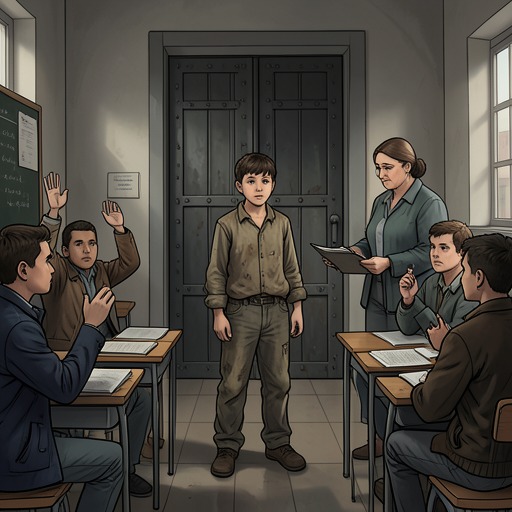
Frank's first school fight
Angela's AshesFrank’s first schoolyard fight at Leamy’s National School grows out of the boys’ insistence that he and his brother are outsiders. When Heffernan turns that suspicion into a public challenge, Frank answers with violence and is punished by Mr. Benson. The episode makes the label “Yank” both a social stigma and the occasion for an adult intervention that condemns the bullying even as it disciplines Frank.
The American boys in the classroom
The boys at Leamy’s want to know why Frank and Malachy speak differently. Their questions turn the brothers’ American background into a spectacle: they ask whether the newcomers are Yanks, then whether they are gangsters or cowboys. The alternatives come from a ready-made picture of America, not from anything the boys know about Frank himself. Before the fight begins, he has already been reduced to a category that the other pupils use to decide how to treat him.
Heffernan presses that category into a direct challenge. Putting his face close to Frank’s, he insists that he is asking a question and demands to know whether Frank is a gangster or a cowboy. Frank says he does not know. When Heffernan pokes him in the chest, Malachy intervenes with a joking division of roles: he is the gangster, Frank the cowboy. Heffernan answers by calling Malachy smart and Frank a stupid Yank, making the older boy’s uncertainty the point of the insult.
From taunt to fight
The boys surrounding Heffernan begin shouting for a fight. He pushes Frank so hard that he falls. Frank wants to cry, but instead experiences the same blackness that had overtaken him in his earlier confrontation with Freddie Leibowitz. He charges Heffernan, kicking and punching; after knocking him down, he tries to seize his hair and bang his head against the ground. The sequence is abrupt: public humiliation, a fall, then an uncontrolled attack that carries the conflict beyond the original teasing.
Mr. Benson stops the fight by taking Frank by the ear and striking him across the legs. He calls him a hooligan and asks whether this is the kind of behavior he brought from America. The punishment makes Frank’s birthplace part of the accusation: the schoolmaster treats the fight as though it confirms the stereotype attached to the word “Yank.” He then orders Frank to hold out each hand and strikes both once with his stick. Frank is sent home to tell his mother that he has been bad and is made to repeat the judgment, “I’m a bad boy.”
Heffernan is rebuked
The episode does not end with Frank’s punishment. Mr. Benson turns to Heffernan and asks whether this was what he had done. Heffernan answers that he was only joking. The master rejects that excuse, telling him it is not the newcomers’ fault that they are Yanks. In the same reprimand, he pointedly imagines Heffernan as the greatest gangster on both sides of the Atlantic, with Al Capone coming to him for lessons, and orders him to leave the two Yanks alone.
That intervention complicates the school’s response to the fight. Frank has been beaten and made to call himself a bad boy, but Heffernan is also explicitly held responsible for the harassment that preceded it. Mr. Benson’s mockery turns the gangster label back on its user: the insult that marked Frank as foreign becomes a sarcastic portrait of Heffernan. The master does not excuse Frank’s assault; instead, the scene distinguishes the punishment of the boy who fought from the rebuke of the boy who provoked him.
The cost of being called a Yank
The fight gives physical form to the brothers’ difficult arrival at school. Their speech marks them out before they have a chance to establish themselves, and the other boys translate that difference into questions about gangsters and cowboys. Malachy can answer with a joke, but Frank’s hesitation leaves him exposed to Heffernan’s contempt; when the crowd calls for a fight, that exposure becomes a test he meets with violence.
The episode also stages a difference between naming and knowing. The boys treat “Yank” as if it explains Frank, while Mr. Benson’s later defense insists that being American is not a fault for which the newcomers should be blamed. Yet the correction comes after Frank has been struck, ordered to repeat his condemnation, and sent home. His first fight therefore ends without a simple victory: he has knocked Heffernan down, but the school’s authority has made him perform the identity of a bad boy even as it tells his tormentor to stop.